Showing posts with label Pulau Semakau. Show all posts

19 September 2008

4 Oct: "Secret Shores of Singapore" Talk at Sungei Buloh

My mum informed me of this talk which will be held on 4 Oct 08 by Ria Tan. She will share on the "Secret Shores of Singapore" through 300-600 recent photos and stories of adventures and discoveries on our living shores. From Changi to Tuas, Sentosa to the Sisters Islands and beyond. Nemos, sea snakes, living corals and more. Ria will also share about some of the threats to our shores, and the many ways ORDINARY PEOPLE CAN MAKE A DIFFERENCE about our little-known shores. I am sure we can learn from her as she is an ordinary person too.


I know your exams are coming, but if you can steal some time from your revisions, I encourage you to attend.

Time: 10.30am-12noon

Venue: Sungei Buloh Wetland Reserve


Contact: info@sbwr.org.sg or call 6794 1401


28 August 2008

Pulau Semakau 17 Aug 08 (Part 1 - Intertidal Walk, Corals)

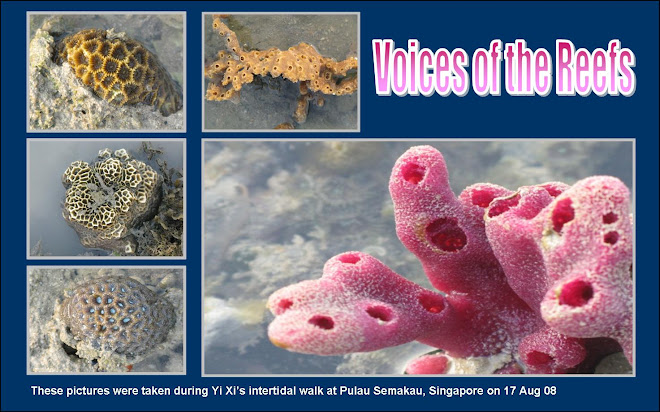
On 17 Aug 08, I woke up at 3am to get ready for our trip to Pulau Semakau. My mother had signed us up for an intertidal walk organised by the Raffles Museum of Biodiversity Research. What we saw was really unbelievable! This affirmed our belief that we need to save the reefs!


Look at all the hard and soft corals spotted! Are they fabulous? Would you have imagined that they can be found along Singapore's shorelines?


Pulau Semakau 17 Aug 08 (Part 2 - STARS)

One of the highlights was seeing the knobbly sea star (Protoreaster Nodosus). This is probably the biggest sea star in Singapore based on body width, as it can grow to about 30cm wide.

This sea star apparently feeds on micro-organisms on seagrass or sediment surfaces. However, it is known to feed on soft corals, sponges, clams etc. when in captivity. But they are not known to survive long in captivity, which suggest that the latter may not be their preferred natural diet.

We also saw a cushion star (Culcita novaeguineae). They feed on corals.

We saw several species of sea stars too. The below are sand-sifting sea stars (Archaster typicus) in a shallow tidal pool, including one pair which is mating!

Pulau Semakau 17 Aug 08 (Part 3 - Sea Cucumbers)

We saw lots of sea cucumbers that day! Not all can be eaten :) This sandfish sea cucumber (Holothuria scabra) is the one often served in Chinese restaurants. They must be probably treated to remove their toxins before they can be consumed.

This ocellated sea cucumber (Stichopus ocellatus) has very striking colours and has lots of "eyespots" on its body, which are basically dark papillae surrounded by a white ring.

Pulau Semakau 17 Aug 08 (Part 4-Flatworms and Nudibranchs)

We also saw many invertebrates along the shoreline! Examples include this Acanthozoon flatworm:

These flatworms are very fragile and tear easily, so handling them is a delicate task. The good news is, they can regenerate their lost body parts.

We also saw this funeral nudibranch (Jorunna funebris). "Nudibranch" means "naked gills" as their gills (the flowery structures on their backs) are exposed, not in their body like most other marine animals.

Just like snails, Nudibranchs are hermaphrodites. This means that they have both male and female reproductive systems. The above Glossodoris nudibranchs (Glossodoris atromarginata) are actually mating!

We were lucky enough to spot a swallowtail headshield slug (Chelidonura pallida). The swallowtail headshield slug has a well-developed "headshield", which is used to plow beneath the sand surface and helps prevent the sand entering the mantle cavity. These slugs feed on tiny flatworms living on coral reef substrate.
Pulau Semakau 17 Aug 08 (Part 5 - Crabs)

Can you spot the hairy crab in this picture? Hairy crabs are masters of camouflage, as they are coloured and textured just like a lump of seaweed.

This is probably a carnivorous crab, as it has sharp pincers and not spoon-shaped ones. It is actually getting ready to attack as it had sensed our presence.


Pulau Semakau 17 Aug 08 (Part 6 - Noble Volutes)

We also spotted 2 noble volutes (Cymbiola nobilis) laying their eggs. Noble volutes are sea snails, but they are fierce predators and kill their prey by smothering them with their foot.


Pulau Semakau 17 Aug 08 (Part 7 - Anemones)

We easily found this gigantic anemone (Stichodactyla gigantea)with a few anemone shrimps in it too! Anemone shrimps have a special protective layer that prevents them from getting stung by the anemone.
Below is a picture of an anemone when it is closed up, meaning that its tentacles are not exposed to the water.


This is an anemone from the Aliciidae family. It gives very painful stings, so we have to handle it carefully.

Pulau Semakau 17 Aug 08 (Part 8 - Others)

We also saw some fan worms! They are actually a type of segmented worm that has feathery structures on its head. They live in a flexible, leathery tube.


This is a Spiral Melongena (Pugilina cochlidium) laying eggs! This snail probably feeds on barnacles.

We were lucky enough to spot an octopus! Can you see it? Octopuses are masters of camouflage, able to change their skin colour according to their surroundings.

I am very impressed with the vast amount of marine life that can be found along the shoreline of Singapore. It is really a surprise to me! Let's do our part to preserve these natural wonders.