Researchers from Oregon State University, NASA and other orgnaisations said today that they have succedded for the first time in measuring the physiology of marine phytoplankon through satelite measurements of its flourescence.
With this new tool and the continued use of the MODIS Aqua satellite, scientists will now be able to gain a reasonably accurate picture of the ocean's health and productivity about every week, all over the planet.Data such as this will be critically important in evaluating the effect on oceans of global warming, climate change, desertification and other changes, the researchers said. It will also be a key to determining which areas of the ocean are limited in their productivity by iron deficiency.
31 May 2009

26 April 2009
The Coral Triangle
The Coral Triangle is a region , covering over 6 million square kilometres, that holds the greatest number of corals, sponges, crustaceans, molluscs and fish on this planet. There are over 600 types of coral, 3000 species of fish, sea turtles, whales, and dolphins. It is now known as the global centre for marine diversity.

Millions of people who depend on tourism and fishing for their livelihoods also live along the shores of the Coral Triangle. Coastal development, over-fishing, and other activities caused by man are threatening this area. I hope that these harmful activities will cease to happen and that the Coral Triangle will be here for future generations to admire.
Recenty, 6 Asia-Pacific countries signed a plan to save the most important area of coral reef in theCoral traingle http://news.bbc.co.uk/2/hi/science/nature/8051709.stm
26 February 2009
Fish with transparent head
A Pacific Barreleye fish was discovered alive in the deep waters off California's central coast by the Monterey Bay Aquarium Research Institute (MBARI). It is the first specimen of its kind to be found with its soft transparent dome intact.

The beady bits on the front of the Pacific barreleye fish aren't eyes but smell organs. The eyes are beneath the green domes, which may filter light. In this picture the eyes are pointing upward--to see prey above in the darkness of the barreleye's deep-sea home. By watching live fish from a remotely operated vehicle and by bringing a barreleye to an aquarium for a study, the scientists discovered that the eyes can pivot, like a birdwatcher pointing a pair of binoculars. The barreleye lives more than 2,000 feet (600 meters) beneath the ocean's surface, where there is little light.

04 February 2009
"Immortal" Jellyfish Swarm World's Oceans

I found another article on the National Geographic website today. The article is very interesting, as it talks about a potentially "Immortal" species of jellyfish.
I feel that if this species of jellyfish continues to multiply, this might mean trouble for the oceans, as there will be too many of this species. Apparently, they are able to transform from an adult back to a baby, and they are able to do it not only once, but over and over again! However, this is only an emergency measure.
There are specimens of these jellyfish all around the world, however, in different areas, they take different forms. Swarms living in the tropical waters have 8 tentacles, while those in temperate regions have 24 tentacles or more.
As interesting as these creatures are, I hope that they will not spread too fast to disrupt the ocean's ecosystem, as that would be disastrous. A problem like that would be difficult to solve.
To read the full article, please visit: http://news.nationalgeographic.com/news/2009/01/090130-immortal-jellyfish-swarm.html
28 December 2008
Southern Line Islands Expedition
Recently, I found an article on the National Geographic website about the Southern Line Islands Expeditions. What is this project about? Well, participants in this project study the ecology of healthy coral reefs, in hope to learn valuable clues that will help save the world's reefs.
In February and March 2009, the Southern Line Islands Expedition will travel to remote central-Pacific islands like Flint, Vostok and Malden to continue the reef studies done in the Northern Line Islands in 2005 and 2007.
I hope that the project will be a success and the participants will find new ways to save the coral reefs.
You can read more on: http://www.nationalgeographic.com/field/projects/line-islands.html
In February and March 2009, the Southern Line Islands Expedition will travel to remote central-Pacific islands like Flint, Vostok and Malden to continue the reef studies done in the Northern Line Islands in 2005 and 2007.
I hope that the project will be a success and the participants will find new ways to save the coral reefs.
You can read more on: http://www.nationalgeographic.com/field/projects/line-islands.html
25 December 2008
28 Dec: Chek Jawa Boardwalk
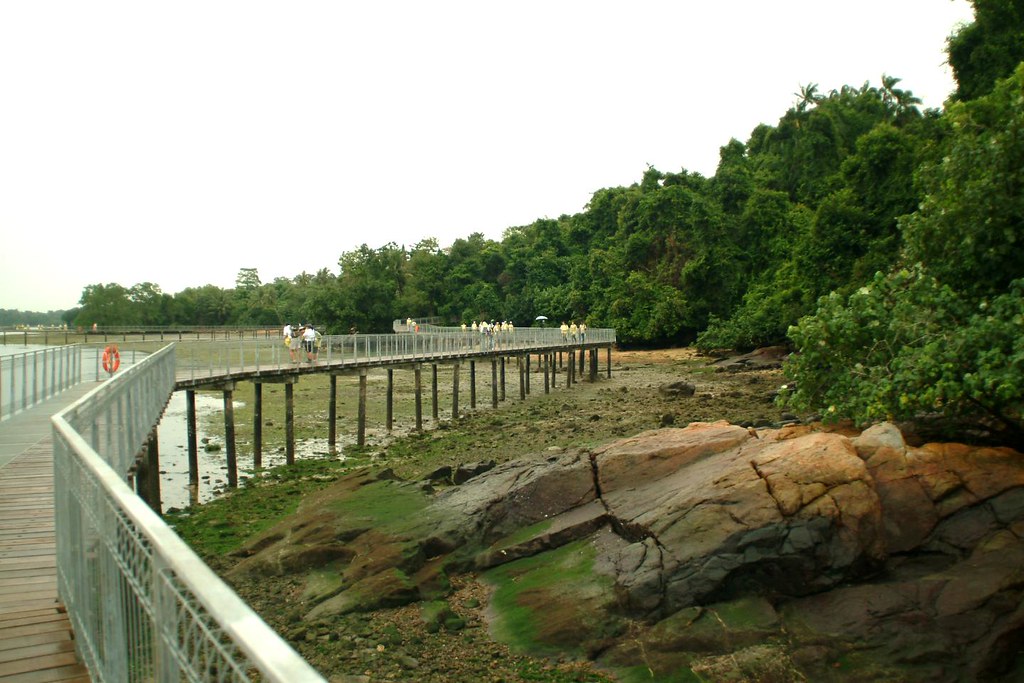
The Naked Hermit Crabs will be organizing a boardwalk at Chek Jawa on 28 December. If you have the time, do go for the boardwalk as it is very interesting and you will get to see many different types of wildlife.
Time: 3 p.m.
Venue: Meet at Chek Jawa Information Kiosk
Duration of walk: 2 hours
To find out more, visit: http://nakedhermitcrabs.blogspot.com/
Time: 3 p.m.
Venue: Meet at Chek Jawa Information Kiosk
Duration of walk: 2 hours
To find out more, visit: http://nakedhermitcrabs.blogspot.com/
17 December 2008
12 Dec: Sentosa Shore Walk
On 12 December, we went to Sentosa for a shore walk. Here are some interesting things we saw during the walk:

This is a coral skeleton.

 Look at this mosiac crab!
Here is the flag used by the Naked Hermit Crabs to mark a spot where there are things for us to see.

Look at this gigantic tire! Although it is a piece of rubbish in the sea, there are wildlife growing on it!
 This is a swimming crab.
  Can you spot the hairy crab?
 This is the flower of the tape seagrass. We also saw the fruit!
This is a polka-dotted nudibranch. Isn't it pretty?

 Corals!!! :)
At the site where we had the walk,the water was amazingly clear and we could see the marine life clearly in the water. I did not expect to see so many different types of marine life, and hope that people will stop polluting the seas so that we will be able to conserve these animals and plants.
16 December 2008
S'pore Coastline Getting Dirtier
I woke up this morning and to my disppointment there was a newspaper article in The Straits Times about Singapore's coastline getting dirtier. Apparently the coastal cleanup in September found 3,448 pieces of trash, which weighed 9,755kg in total! The trash included 39 tyres, refrigerators, and the usual rubbish items.
Top 5 Rubbish Items:
1. styrofoam pieces
2. plastic bags
3. cigarette/cigarette filters
4. food containers/wrappers
5. straws/stirrers
Top 5 Dirtiest Beaches:
1. Lim Chu Kang
2. Kranji
3. Pulau Ubin
4. Changi
5. Sembawang
This article reminded me of the 2 big items I saw during our Sentosa Interdial Walk on 12 Dec 08.
... a giantic tyre

... a beach chair


It seems that our efforts to advise the public on not throwing litter into the sea have made little progress. I hope that with this post, some of you might change your habits and save marine life. At the same time, do help to spread the message around.
Registration for 2009 International Coastal Cleanup will open in Mar 09 at the website http://coastalcleanup.nus.edu.sg
29 November 2008
2 Nov 08: The New Paper Big Walk


Although we did not win the contest, we still had a wonderful experience at the Marina Barrage and during the walk. We hope that others will still take note of our message and spread it around the world.
15 November 2008
17 Oct 08: Pasir Ris
This is really an overdue post as we were busy with our exams earlier. During that period, we were bored to death with studying and so one evening our parents brought us to Pasir Ris Beach to relax for a while or so. It turned out that it was low tide then, so we went to the beach for a walk.
 We saw 2 carpet anemones! At first we thought it was coral until we realised that it was soft and bendy.


There were a lot of dead crabs too. The worst thing was they were found tangled in or alongside rubbish thrown by inconsiderate beach-walkers.


And we saw a man carrying a bag of gong gong, which is a common delicacy in Singaporean seafood. Not sure if they are safe to eat as the waters are so badly polluted.

Worst of all , we saw a dilapidated Hello Kitty handbag! I wonder why its owner had to throw it away as it is polluting the sea and I believe that the bag was in good condition at that time.
We saw 2 carpet anemones! At first we thought it was coral until we realised that it was soft and bendy.
There were a lot of dead crabs too. The worst thing was they were found tangled in or alongside rubbish thrown by inconsiderate beach-walkers.


To our surprise, there were starfishes too.


And we saw a ribbonworm!
Hermit crabs wih shells of all shapes and sizes were also found among the rocks. Once again, let me remind you that we should not collect seashells as you are depriving hermit crabs and other animals of a home.

We saw some sea snails too! Unfortunately their shells were covered with muddy sand so we could not see the colours on them. I am sure that they are colourful.

We saw some sea snails too! Unfortunately their shells were covered with muddy sand so we could not see the colours on them. I am sure that they are colourful.
And we saw a man carrying a bag of gong gong, which is a common delicacy in Singaporean seafood. Not sure if they are safe to eat as the waters are so badly polluted.
Worst of all , we saw a dilapidated Hello Kitty handbag! I wonder why its owner had to throw it away as it is polluting the sea and I believe that the bag was in good condition at that time.


I feel that we should not pollute this sea just because its waters are classified as unsafe to swim in. This will only just make the situation worse.
30 October 2008
Whale Stranded
On the 15th of October, a beached Bryde's whale was beached on Kuala Nenasi estuary in eastern Pahang state. It died a day later despite the villagers' efforts to save it. The shocking thing was that he preliminary findings of an autopsy showed the female had swallowed a black plastic bag, a rope and a bottle cap, which clogged its intestine.

I feel that we should not throw litter into the sea because we are actually harming innocent animals. I hope that this posting will allow you to realise the drastic effects of littering on marine life.
24 October 2008
Young Marine Biologist Award: Winning Blogs
We have not been posting here recently because of the exams. Now that they are finally over, we will continue our regular updates again ;)
Our blog won the 2008 Young Marine Biologist Award (YMBA): Best Blog for Primary Category. We were thrilled! We hope that with this win, more people will get to know about our blog and hear the voices of the reefs. We thought that you might want to look at the other winners of the YMBA as well as they are very nicely done up to promote the reefs:
Secondary Category
Tertiary Category
21 September 2008
New Species Discovered On Aussie Reefs
Did you read the article on The Straits Times yesterday 20 Sep 08? Marine scientists said that they have discovered hundreds of new animal species on Ausse reefs (Great Barrier Reef and Ningaloo Reef). This is a wonderful achievement and I was thrilled with the pictures taken. When I was at Ninglaoo Reef in June 2008, this discovery was not known yet. Anway, I hope that when I next visit Ningaloo Reef, I have the opportunity to view some of the new species :)
I like this twisted nudibranch, (Chromodoris Elizabethina), on the reef face off Heron Island most. It is very bright and colourful.
 About half of the 300 soft corals found are thought to be new discoveries, although they will only be given names and classified formally once the scientists have compared them against existing species. Unlike their hard-bodied cousins, soft corals do not build reefs but are nevertheless considered vital for the marine environment. These colourful animals can dominate some regions of the sea, covering up to 25 per cent of the ocean floor.
 and a ctenophore or comb jellyfish
 You can see more pictures on http://www.guardian.co.uk/environment/gallery/2008/sep/18/wildlife.australia?picture=337754721
I like this twisted nudibranch, (Chromodoris Elizabethina), on the reef face off Heron Island most. It is very bright and colourful.
About half of the 300 soft corals found are thought to be new discoveries, although they will only be given names and classified formally once the scientists have compared them against existing species. Unlike their hard-bodied cousins, soft corals do not build reefs but are nevertheless considered vital for the marine environment. These colourful animals can dominate some regions of the sea, covering up to 25 per cent of the ocean floor.The latest discovery is a result of a four-year project centred on the extensive coral reefs of western and north-western Australia and is part of a larger effort to take a census of all marine life in the world, due to be finished in 2010. When complete, the census will be used as a "baseline" to try to quantify the rate at which species are becoming extinct in the marine environment. Coral reefs are considered to be the rainforests of the sea because of their rich biodiversity. It is estimated that something between one million and nine million species of marine creatures live in and around coral reefs, but scientists have little idea of the precise numbers.
Here is a dendronepthya soft coral

ans a colonial salp jellyfish
and a ctenophore or comb jellyfishYou can see more pictures on http://www.guardian.co.uk/environment/gallery/2008/sep/18/wildlife.australia?picture=337754721
19 September 2008
4 Oct: "Secret Shores of Singapore" Talk at Sungei Buloh
My mum informed me of this talk which will be held on 4 Oct 08 by Ria Tan. She will share on the "Secret Shores of Singapore" through 300-600 recent photos and stories of adventures and discoveries on our living shores. From Changi to Tuas, Sentosa to the Sisters Islands and beyond. Nemos, sea snakes, living corals and more. Ria will also share about some of the threats to our shores, and the many ways ORDINARY PEOPLE CAN MAKE A DIFFERENCE about our little-known shores. I am sure we can learn from her as she is an ordinary person too.

I know your exams are coming, but if you can steal some time from your revisions, I encourage you to attend.
Time: 10.30am-12noon
Venue: Sungei Buloh Wetland Reserve
Website: http://www.sbwr.org.sg/
Contact: info@sbwr.org.sg or call 6794 1401
See more on http://wildsingaporehappenings.blogspot.com/2008/09/4-oct-sat-secret-shores-of-singapore.html
11 September 2008
Make Singapore a Coral Haven
This newspaper article is extracted from My Paper published on 10 Sep 08. In the "Blue Plan" proposed by a group of marine conservationists, 10% of the reefs in Singapore should be turned into sanctuaries. These could be categorised into "no-go zones", where access is granted only for scientific purposes. Other areas with limited acess could be allowed, or opened under proper management. I strongly support this movement as it will help in the conservation of the marine life here. You can read more about coral reefs in Singapore at http://coralreef.nus.edu.sg/
You can read more about coral reefs in Singapore at http://coralreef.nus.edu.sg/
07 September 2008
Is West Coast Park's Beach a Rubbish Dump?
We went to West Coast Park and were expecting nice scenery along the beach, perhaps even a reef. However, to our horror, this was what we saw...

There was a lot of rubbish scattered along the shoreline, especially water bottles!

 We can't even imagine ourselves living in this sort of environment. How about the marine life? This scene looks very bad on the supposedly "tranquil" West Coast Park! We appeal to all of you to do your part, not to litter and help to clean up the coast. The International Coastal Clean-up is coming. Do your part. See
http://coastalcleanup.nus.edu.sg/
We should also learn some lessons from the Japanese, as they are planning the largest clean up event. See
http://www.terradaily.com/reports/Japanese_plan_worlds_largest_cleanup_999.html

There was a lot of rubbish scattered along the shoreline, especially water bottles!

 We can't even imagine ourselves living in this sort of environment. How about the marine life? This scene looks very bad on the supposedly "tranquil" West Coast Park! We appeal to all of you to do your part, not to litter and help to clean up the coast. The International Coastal Clean-up is coming. Do your part. See
http://coastalcleanup.nus.edu.sg/
We should also learn some lessons from the Japanese, as they are planning the largest clean up event. See
http://www.terradaily.com/reports/Japanese_plan_worlds_largest_cleanup_999.html
31 August 2008
What are Coral Reefs?
Coral reefs are one of the most biologically diverse marine eco-systems on the Earth! Many think that corals are plants, but they are actually animals.

Read more at: http://www.nature.org/joinanddonate/rescuereef/explore/facts.html

 A coral reef is composed of a calcereous exo-skeleton secreted by billions of tiny animals called polyps. Millions of polyps grow on top of the limestone remains of former colonies to create the massive reefs. It takes years for some corals to grow even one centimetre! They range in size from a pinhead to a few feet in length. Amazingly, these tiny animals form the only natural structure visible from space.
Each polyp lives in a symbiotic relationship with a type of algae, zooxanthellae, that gives the coral its colour.
Read more at: http://www.nature.org/joinanddonate/rescuereef/explore/facts.html
Subscribe to:
Posts (Atom)


